
A weak creative testing cadence does more than slow down production. It traps media teams in the worst possible operating mode: recycling tired winners, making budget decisions on thin data, and blaming the platform when acquisition costs rise.
Paid growth depends on a steady flow of credible creative signals. That requires more than producing a high volume of ads. It requires a system that decides what to test, how long to test it, when to cut it, and how to turn a winner into a scalable campaign without muddying the data.
For growth teams spending meaningful budgets across Meta, Google, TikTok, Taboola, and other channels, cadence is the operating discipline that connects creative production to profitable media buying.
What a Creative Testing Cadence Actually Does
A creative testing cadence is the recurring schedule and decision framework used to launch, evaluate, iterate, and scale ad creative. It defines the pace of testing, but more importantly, it defines the quality of the learning process.
Without a cadence, creative testing becomes reactive. A buyer requests new ads after performance declines. Designers produce a batch based on vague feedback. Campaigns launch at inconsistent intervals. Results come back mixed because several variables changed at once. The team has activity, but not insight.
A disciplined cadence creates a predictable loop: develop hypotheses, produce focused variations, launch under controlled conditions, read performance against agreed thresholds, and use the result to inform the next batch. The goal is not simply to find one winning ad. The goal is to build a repeatable system for finding the next winner before the current one loses efficiency.
That distinction matters because creative fatigue is not an exception in paid acquisition. It is a normal operating condition. Audiences saturate, competitors copy angles, platform delivery shifts, and a message that worked for one segment may fail for another. Teams that test consistently have options. Teams that wait for performance to break are forced to react under pressure.
The Right Cadence Depends on Spend and Signal Speed
There is no universal number of ads to launch per week. The right testing velocity depends on spend, conversion volume, offer complexity, audience size, and how quickly a platform can generate usable data.
A brand spending $5,000 per day on Meta with a high-volume ecommerce offer can support a much faster creative cycle than a B2B company spending $500 per day on a long sales cycle. The first team may be able to test multiple new concepts every week. The second may need fewer, more deliberate tests and leading indicators that go beyond immediate customer acquisition cost.
The mistake is copying another company’s output target without considering its signal capacity. Launching 30 new ads when the account can only generate meaningful data for five creates noise, splits spend, and delays decisions. Launching one ad every few weeks in a high-spend account leaves too much budget concentrated in aging creative.
A practical starting point is to set cadence based on how many distinct creative concepts the account can fund with enough spend to make a decision. From there, build production capacity around that number. Concept volume matters more than superficial variation volume. Ten new hooks built around the same claim are not ten independent tests.
Separate Concepts From Variations
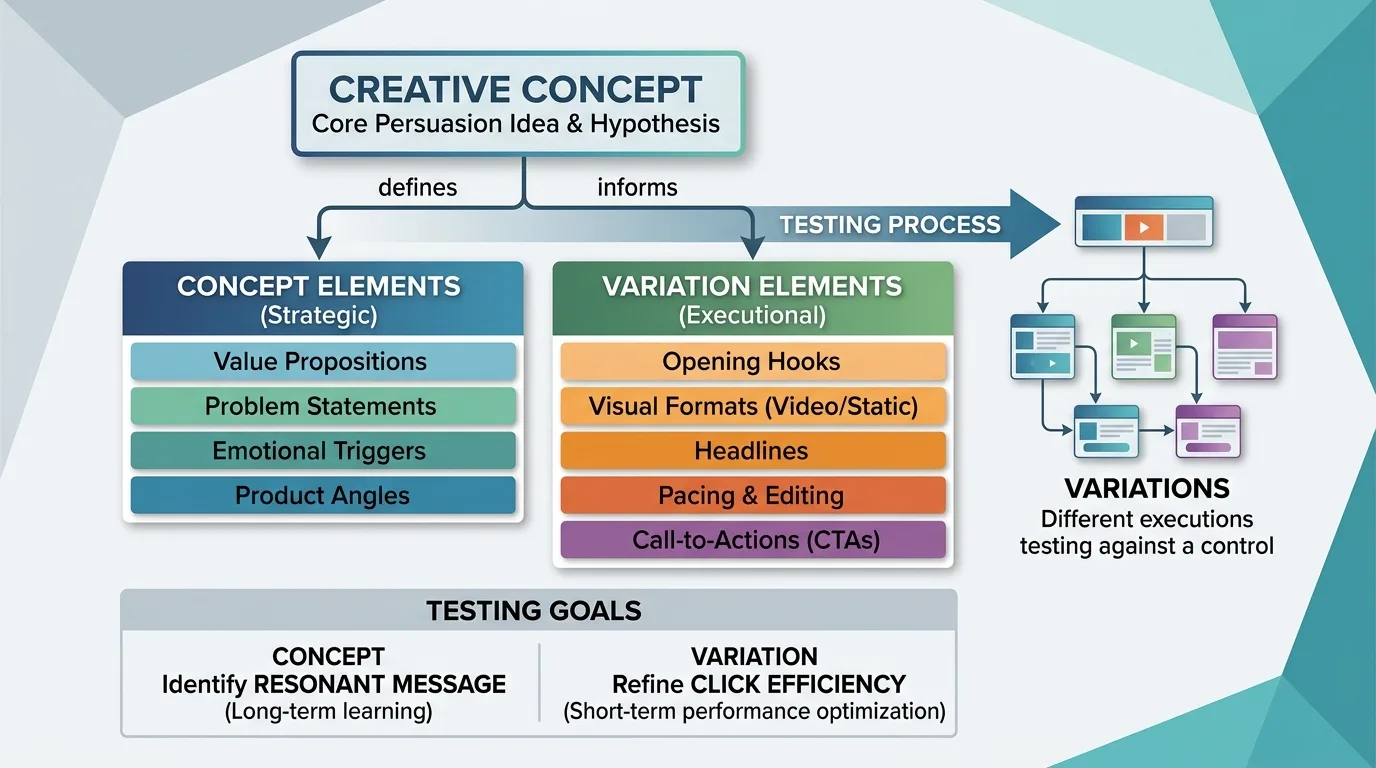
A concept is the core persuasion idea: a customer problem, proof point, objection, product mechanism, creator perspective, offer framing, or emotional trigger. A variation changes an executional element within that concept, such as the opening hook, visual format, headline, length, or call to action.
| Parameter | Concept | Variation | | --- | --- | | Definition | Core message angle, consumer psychology, or fundamental persuasion hook. | Executional adjustments of a single core message (e.g., visual swap, CTA, headline). | | Goal | Identify which underlying marketing message resonates with the target audience. | Refine the performance and click efficiency of an already successful message. | | Elements Tested | Value propositions, problem statements, primary angles, or offer structures. | Hook elements, thumbnail images, pacing, music, captions, or button CTAs. | | Lifespan | Long-term; can sustain campaigns for months when executed in various ways. | Short-term; highly prone to rapid ad-level performance fatigue. | | Budget Impact | Requires dedicated budget to establish statistical baseline for a new angle. | Allows for highly efficient allocation adjustments without shifting core message. |
Both have value, but they answer different questions. Concept tests help a team learn what message the market responds to. Variations help refine how that message is delivered.
When performance is deteriorating, teams often overproduce variations because they are faster to make. New colors, different subtitles, and edited opening frames can help at the margin, but they will not fix a message that has stopped connecting. A healthy testing plan reserves capacity for both new concepts and iterations of proven themes.
Build the Cadence Around a Weekly Operating Loop
The strongest creative programs run on a fixed weekly rhythm, even when production and launch volume vary. That rhythm prevents strategic work from getting pushed aside by daily campaign management.
Weekly Creative Cadence Checklist
- Monday: Performance Review & Audit — Extract data at the concept level, evaluating front-end hook rates alongside down-funnel acquisition KPIs.
- Tuesday: Hypothesis & Briefing — Translate performance insights into clear hypotheses and brief creative teams on new concepts and variations.
- Wednesday: Production Kickoff — Design and build modular, structured assets using high-converting creative structures.
- Thursday: QA & Scheduled Launch — Review visual assets, verify naming conventions, and queue ads under controlled testing setups.
- Friday: Early Signal Assessment — Monitor initial launch metrics to safeguard budgets and identify early-stage winners or drop-offs.
At the start of the cycle, review performance at the concept level. Do not only ask which individual ad had the lowest CPA. Ask which themes are producing qualified clicks, strong conversion rates, efficient purchases, better lead quality, or higher downstream value. A creative with a slightly higher front-end CPA may be the better scaling asset if it drives stronger revenue or retention.
Then convert the findings into a testing brief. Each proposed asset should have a clear hypothesis. For example: customers may respond better to a direct comparison with their current workaround than to a broad product demonstration. Or: a creator-led explanation may improve trust for a high-consideration subscription offer. A brief built around hypotheses gives the creative team direction and gives buyers a standard for interpreting results.
Production follows, with templates and modular components where appropriate. High velocity does not require generic ads. It requires an organized production system that can reuse proven structures while changing the message, proof, audience context, and visual treatment.
Launches should happen on scheduled days whenever possible. This makes spend allocation, reporting, and performance review more consistent. It also reduces the common problem of new ads being released randomly throughout the week, then judged against different market conditions.
At the end of the cycle, decide whether to cut, iterate, hold, or scale. Those decisions should be documented in a shared creative intelligence system. Otherwise, teams relearn the same lessons every quarter and keep testing angles that already failed.
Set Decision Rules Before Ads Go Live
Creative testing loses credibility when the rules change after results appear. Define success thresholds before launch, while acknowledging that not every channel offers the same level of immediate certainty.
For direct-response ecommerce, the key decision metric may be CPA, blended efficiency, or contribution margin after a minimum spend threshold. For lead generation, it may be cost per qualified lead, appointment rate, or sales-accepted lead rate. For mobile apps, it may be cost per install combined with early retention or event completion. The metric must reflect business value, not merely cheap traffic.
Early indicators still matter. Hook rate, thumb-stop rate, click-through rate, landing page view rate, and conversion rate can diagnose why an asset is winning or losing. They should not replace the business outcome. A high click-through rate paired with weak conversion often means the creative created curiosity without setting the right expectation.
It also helps to define a learning window. Some assets should be cut quickly because they fail to earn engagement or generate any conversion signal. Others deserve more time because the conversion event is delayed or the audience is smaller. The trade-off is clear: cutting too fast can kill a viable concept before it receives enough delivery, while waiting too long wastes budget that could fund the next test.
Protect the Test From Media Buying Noise
Creative and media are one system. An excellent creative test can still produce misleading results if campaign structure, audience mix, optimization event, placement, or budget changes at the same time.
Where possible, keep the environment stable while evaluating a new creative. Avoid launching a new batch alongside a major bid strategy change. Avoid comparing one asset placed in a broad prospecting campaign with another asset confined to a narrow retargeting audience. And avoid declaring a winner based solely on a short-lived delivery spike.
This does not mean every test needs laboratory-level control. Paid media is dynamic, and perfect isolation is rarely possible at scale. It means the team should know which variables changed and be honest about confidence levels. Directional learning is useful, but it should be labeled as directional rather than treated as proof.
Operational tooling becomes essential as volume grows. Conversion Collective uses centralized campaign systems to maintain launch consistency and connect creative results to media outcomes. Whether a team uses internal tooling or a different workflow, the standard should be the same: every asset needs a clear naming structure, hypothesis, launch date, audience context, and outcome.
Scale Winners Without Burning Them Out
Finding a winning creative is the midpoint, not the finish line. The next step is to determine whether the winner is portable across audiences, placements, formats, and budget levels.
Start by increasing exposure in the environment where it proved itself. Then create controlled extensions: new hooks using the same core angle, shorter and longer edits, static adaptations, creator variations, or audience-specific versions. This preserves the message that worked while creating more inventory around it.
Do not immediately turn every winner into dozens of near-identical ads. That can accelerate fatigue and make reporting harder. Scale in layers. Keep the original as a benchmark, test adjacent executions, and monitor whether incremental versions add new reach or simply cannibalize delivery.
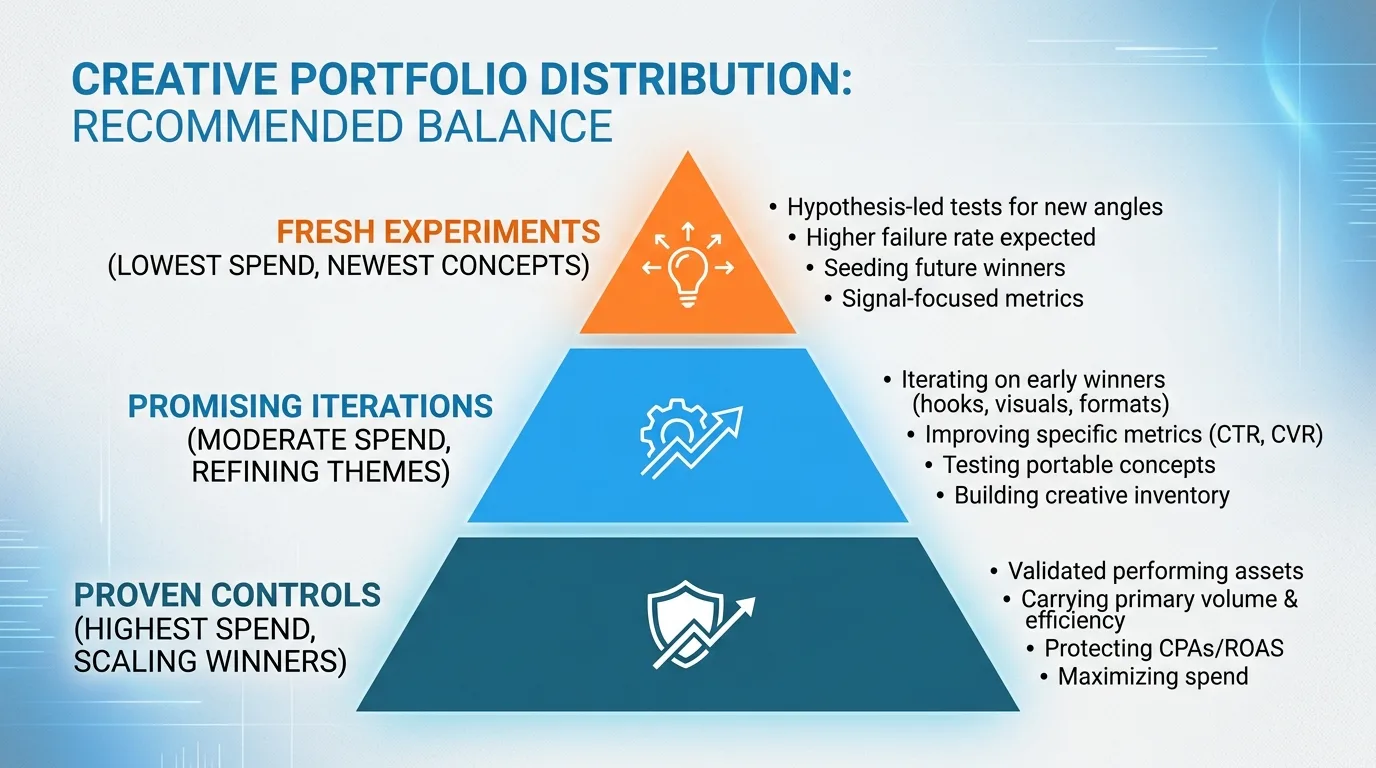
A mature account usually has three active creative groups at once: proven control assets carrying spend, promising iterations earning more budget, and fresh concepts generating future learning. If all spend sits in the control group, fatigue will eventually catch up. If too much spend sits in experiments, efficiency becomes unstable. The balance changes by growth stage, but the portfolio approach keeps the account moving forward.
Make Cadence an Accountability System
The real value of a creative testing cadence is accountability. It makes clear whether creative is being produced against business needs, whether media spend is funding learning, and whether the team can explain why performance changed.
Track a small set of operating metrics alongside campaign outcomes: concepts launched, assets launched, time from brief to launch, percent of tests that reached a decision, winning concept rate, and the share of spend supported by recently tested creative. These metrics expose bottlenecks that a CPA report alone will miss.
If production is fast but few tests reach a decision, the issue may be fragmented spend or weak launch structure. If winners are found but cannot scale, the issue may be narrow audience fit or a weak landing-page match. If no concepts win for several cycles, revisit the customer insight, offer, and market message instead of asking for more visual variations.
The best cadence is not the one that generates the most ads. It is the one that turns every week of spend into clearer decisions, stronger creative inventory, and more control over profitable growth.


